
Solar Battery vs Whole-Home Generator — Which Is Better for Utah Homes?
A licensed Utah master electrician breaks down every real-world difference between solar battery backup and standby generators in 2026 — cost, runtime, noise, maintenance, ROI, and which option makes sense for your specific Salt Lake County or Utah County home.

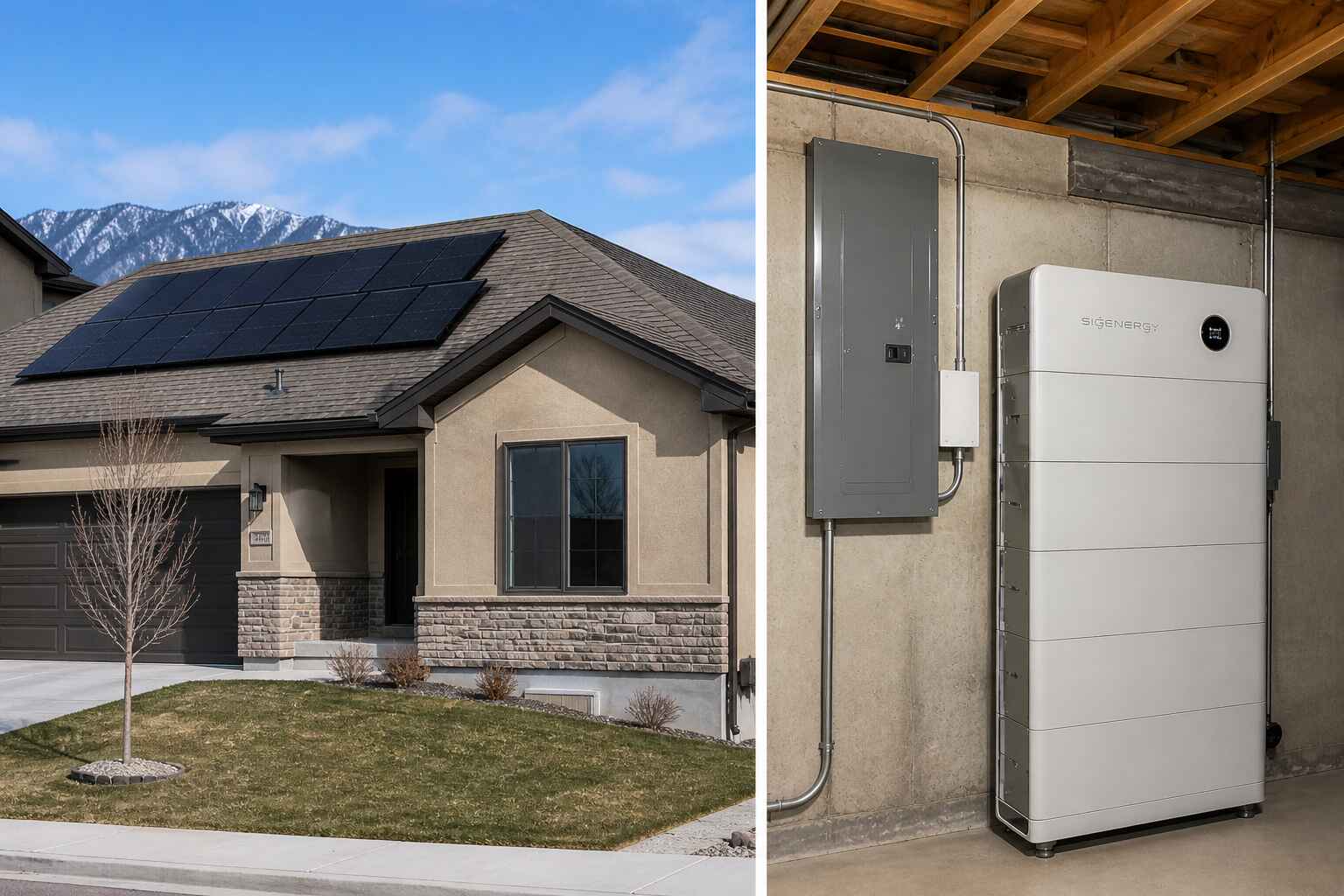
For most Utah homeowners in 2026, a solar battery system outperforms a whole-home generator on cost, noise, maintenance, and ROI when paired with solar panels. Whole-home generators (Generac, Kohler) win only when you need unlimited runtime for extended multi-day outages and have natural gas access. Both qualify for the RMP Wattsmart rebate (battery only) and cost between $8,000–$20,000 installed.
- Solar Battery Installed
- $9,500–$18,000 (after RMP rebate)
- Whole-Home Generator
- $8,000–$20,000 installed + $400/yr fuel
- RMP Rebate Available
- Battery: YES ($400/kW up to $2,000) · Generator: NO
- Best Choice for Most Utah Homes
- Solar battery — lower TCO, quieter, zero fuel cost
Every week, Utah homeowners contact Elite Electric asking the same question: “Should I get a solar battery or a whole-home generator?” It is one of the most consequential home energy decisions you will make in 2026 — both in terms of upfront investment and what happens when the grid goes down.
This article gives you the honest, technically grounded comparison that generator salespeople and solar marketing materials won’t. We’ll cover every real-world factor that matters for Utah homes: cost, runtime, noise, fuel, maintenance, rebate eligibility, installation complexity, and long-term ROI. By the end, you’ll know exactly which option fits your home, your budget, and your specific utility situation.
Rocky Mountain Power’s Wattsmart Battery Rebate ($400/kW up to $2,000) applies only to battery storage systems — not to generators. This rebate alone shifts the TCO calculation significantly in favor of battery storage for most RMP-territory homeowners in Sandy, Draper, South Jordan, Herriman, Lehi, Orem, and surrounding cities. Murray, Provo, and Spanish Fork homeowners are on different utilities and the RMP rebate does not apply there.
How Solar Battery Systems and Whole-Home Generators Work
Understanding how each technology actually operates reveals why they perform so differently in real outage scenarios — and why the “just get a generator” advice most homeowners receive is often incomplete.
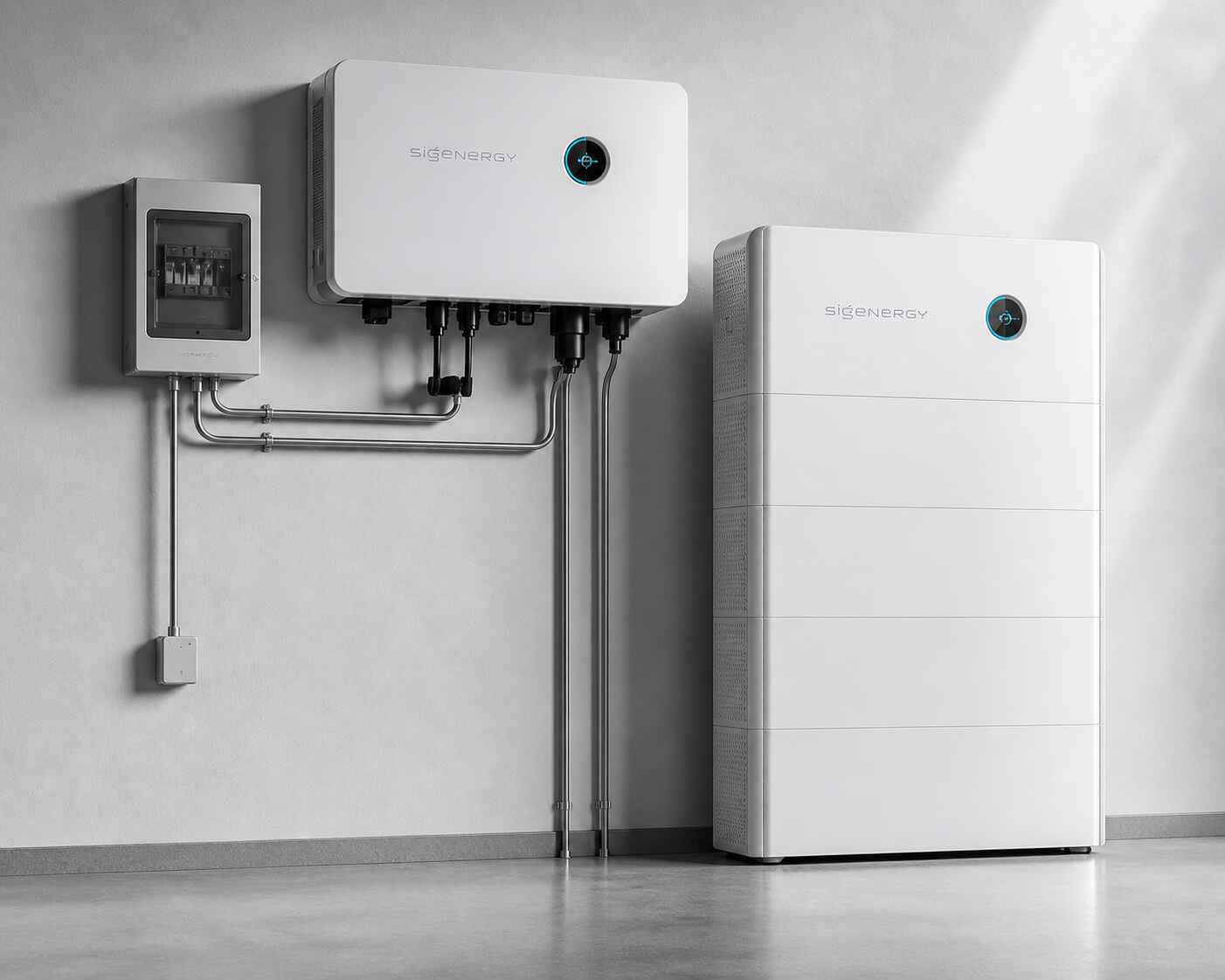

How a Solar Battery System Works During an Outage
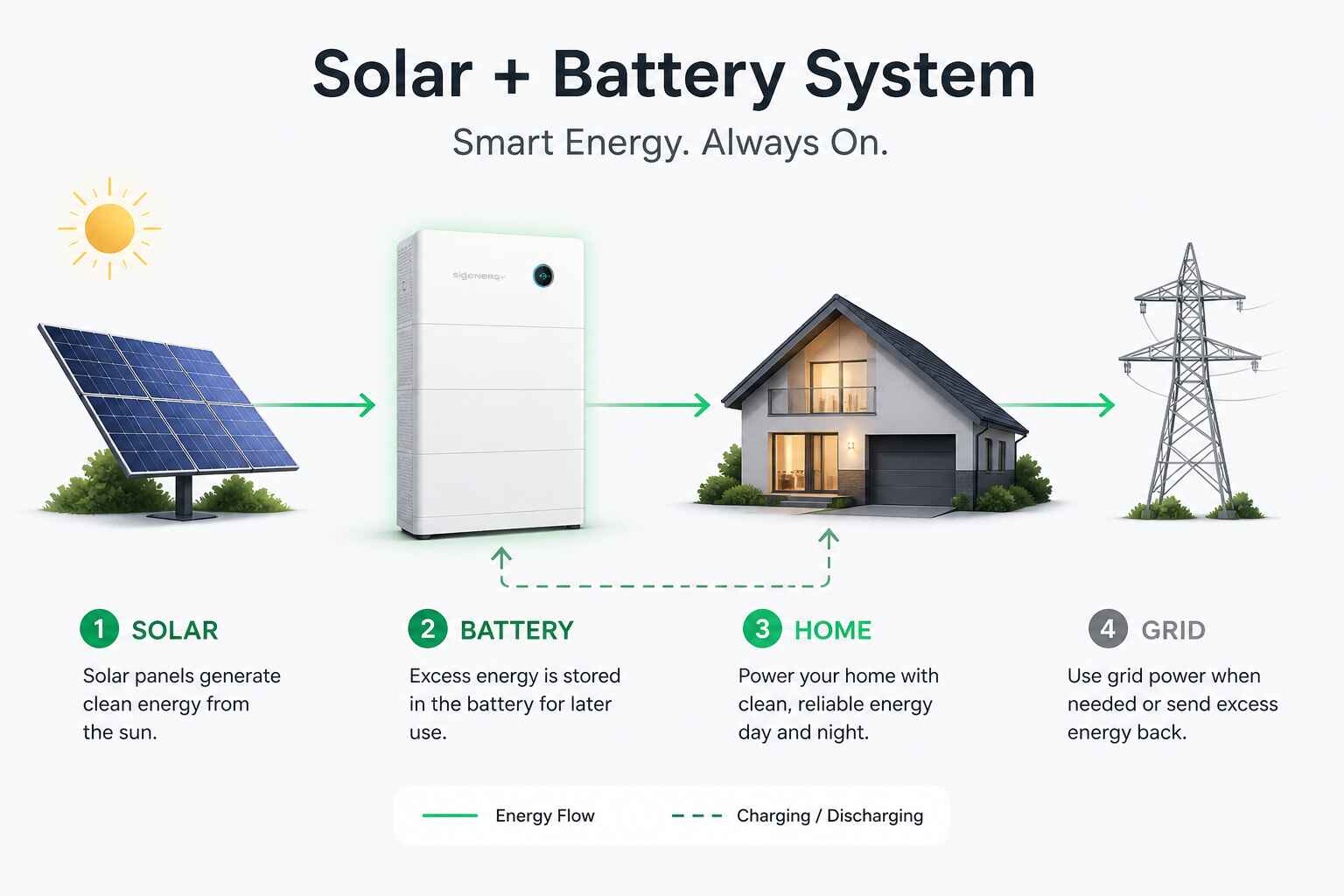
A solar battery system (Sigenergy SigenStor, Tesla Powerwall 3, or Enphase IQ10C) stores electrical energy during the day — either from your solar panels or from the grid during cheap off-peak hours. When your utility grid goes down, the battery’s transfer switch activates within milliseconds (typically 20–100ms). This is fast enough that your lights, refrigerator, medical devices, and internet router never even blink. Your household runs entirely from stored battery power until the grid comes back or your solar panels recharge the battery the next morning.
The key constraint is capacity: a 13.5 kWh Tesla Powerwall 3 or a Sigenergy SigenStor 5 kWh unit provides a finite amount of energy. How long it lasts depends entirely on what loads you run during the outage. A disciplined household can stretch 13.5 kWh for 24–36 hours. Running central AC continuously will drain it in 4–8 hours.
How a Whole-Home Standby Generator Works
A standby generator (typically Generac, Kohler, or Cummins) is a permanently installed natural gas or propane appliance that sits next to your home. When grid power fails, an automatic transfer switch detects the outage and starts the generator engine within 10–30 seconds. During those seconds, your home has no power. The generator then runs your home’s essential circuits or entire electrical panel as long as fuel is available.
For natural gas generators, fuel is essentially unlimited since natural gas lines rarely fail during power outages. This is the generator’s most significant advantage: indefinite runtime with no recharging needed. The tradeoffs are substantial though — noise (65–75 dB at 23 feet, comparable to a lawn mower), mandatory weekly self-test cycles, annual professional servicing ($150–$300/year), and zero rebate eligibility from Rocky Mountain Power.
Battery systems use an automatic transfer switch (ATS) that activates in milliseconds. Generators use an ATS that takes 10–30 seconds. For most households this doesn’t matter. For homes with medical equipment (CPAP, home oxygen, infusion pumps), the millisecond switchover of a battery system is medically important. Elite Electric’s Sigenergy installations include ATS configuration specifically for medical-priority loads at no extra charge.
Full Solar Battery vs Generator Comparison Table — Utah 2026
This is the side-by-side comparison that covers every factor Utah homeowners ask about when making this decision. Every figure is sourced from manufacturer specifications and Elite Electric’s actual 2026 installation costs in Salt Lake County and Utah County.
| Factor | 🔋 Solar Battery | ⚙ Whole-Home Generator |
|---|---|---|
| Installed Cost (Utah 2026) | $9,500–$18,000 | $8,000–$20,000 |
| RMP Wattsmart Rebate | ✓ Up to $2,000 | ✗ Not eligible |
| Outage Switchover Speed | 20–100 milliseconds | 10–30 seconds |
| Runtime | Finite (recharges daily from solar) | Unlimited (with gas supply) |
| Fuel Cost (Ongoing) | $0 (solar recharge) | $300–$600/yr (gas) |
| Annual Maintenance | None required | $150–$300/yr (servicing) |
| Noise During Operation | Silent (0 dB) | 65–75 dB (lawn mower level) |
| Installation Complexity | 1 day (electrical permit) | 2–3 days (gas + electrical permits) |
| HOA Approval Needed | Rarely required | ◆ Often required (noise) |
| Reduces Monthly Bills | ✓ Yes (peak TOU avoidance) | ✗ No (only runs in outages) |
| Solar Integration | Native (stores solar excess) | ✗ Not compatible |
| EV Charging During Outage | ✓ Yes (if sized correctly) | ✓ Yes |
| Medical Device Priority | Millisecond switch — critical | 10–30s gap (not ideal) |
| Lifespan | 10–15 years (warranty) | 20–30 years (maintained) |
| 10-Year TCO (Total Cost) | $9,500–$18,000 | $11,500–$23,000 |
| Property Value Impact | +$15,000–$25,000 (with solar) | Minimal to +$3,000–$5,000 |
| Emissions | Zero (no combustion) | CO emissions (outdoor exhaust) |
| Utah Climate Performance | 222+ sunny days, ideal recharge | Not weather-dependent |
The table makes clear why battery systems win on most criteria for Utah homes. The generator’s only irreplaceable advantage is unlimited runtime for extended multi-day outages where solar recharge is impossible or insufficient.
2026 Cost & ROI Breakdown for Utah Homeowners
Cost comparison between these two technologies requires looking beyond the installation invoice. The 10-year total cost of ownership (TCO) tells a very different story than the initial price tag.
- Single Sigenergy SigenStor From $9,500
- Tesla Powerwall 3 (single) From $10,500
- Enphase IQ10C (single) From $9,000
- Dual battery system $16,000–$22,000
- RMP Wattsmart rebate Up to −$2,000
- Annual maintenance $0
- Annual fuel cost $0 (solar)
- 10-year running cost $0–$0
- Generac 20kW standby $10,000–$14,000
- Kohler 20RCAT standby $11,000–$16,000
- Transfer switch + install Included above
- Gas line extension $500–$2,000 extra
- No rebate available −$0
- Annual servicing $150–$300/yr
- Natural gas usage $300–$600/yr est.
- 10-year running cost $4,500–$9,000
The TCO Math Over 10 Years
A $12,000 solar battery installation with zero annual running costs costs $12,000 over 10 years. A $12,000 generator installation with $600/year in fuel and $200/year in servicing costs $20,000 over 10 years. The battery wins by $8,000 — and that doesn’t account for the monthly bill reduction from peak-hour TOU avoidance that battery systems provide but generators don’t.
How the RMP Wattsmart Rebate Changes the Math
Rocky Mountain Power’s Wattsmart Battery Rebate provides $400 per kW of battery capacity, up to $2,000 per household. For a 13.5 kWh Tesla Powerwall 3 or a comparable Sigenergy SigenStor system, this means $2,000 off the installed cost — a rebate that generators simply do not qualify for. Elite Electric handles the complete RMP application for every battery installation at no additional charge.
Combined with the battery’s monthly utility bill savings from time-of-use arbitrage (charging during cheap overnight hours, discharging during RMP’s expensive 4–9PM peak window), the effective payback period for a solar battery in Sandy, Draper, or South Jordan is typically 7–10 years when installed alongside solar panels.
Many Utah homeowners don’t realize that if your natural gas service line isn’t already near the generator’s planned location, a gas line extension adds $500–$2,500 to the project cost. Newer subdivisions in Herriman, Saratoga Springs, and Eagle Mountain sometimes have gas service farther from the home’s ideal generator pad location than expected. Always get a gas line extension quote before finalizing a generator budget.
Runtime & Capacity Analysis — How Long Will Each System Last?
Runtime is where the solar battery vs generator comparison gets nuanced — and where battery marketing sometimes overpromises. Let’s be precise about what each system can actually power for how long.
Solar Battery Runtime: What Can You Run and for How Long?
A 13.5 kWh Tesla Powerwall 3 contains 13.5 kilowatt-hours of usable energy. Here is how long that energy lasts running common Utah household loads:
- Essential loads only (refrigerator + lights + phone charging + internet): 24–48 hours
- Essential + HVAC fan only (no compressor): 16–24 hours
- Essential + 1-ton mini-split AC (1,200W): 8–12 hours
- Essential + central 3-ton AC (3,500W): 4–6 hours
- Essential + electric range cooking (2,400W): 5–8 hours
- Full home load (average Utah home): 6–10 hours
The critical advantage that changes these numbers entirely: solar recharge. If your battery depletes overnight but you have 8–12 solar panels on your roof, the system begins recharging at sunrise. Sandy, UT gets an average of 6.1 peak sun hours per day from April through October — enough to recharge a 13.5 kWh battery approximately 60–80% in a single day, depending on panel count and system efficiency.
Generator Runtime: Effectively Unlimited (With Caveats)
A natural gas standby generator can run indefinitely as long as the gas line maintains pressure. In Utah, natural gas infrastructure is extremely reliable — the state’s gas distribution network has never experienced a widespread multi-day failure. This means a properly installed Generac or Kohler standby generator in Sandy or Draper can power your home through a 7-day or even 14-day grid outage with zero concern about running out of energy.
The practical caveat: generator engines run best when loaded at 50–80% of rated capacity. A 20kW Generac powering a lightly-loaded home wastes fuel and accelerates engine wear. And during the generator’s mandatory weekly self-test (30 minutes, full noise, even at 6AM Sunday morning), your neighborhood will hear it.
Rocky Mountain Power’s SAIDI (System Average Interruption Duration Index) data shows the average Utah outage in 2024 lasted 2.7 hours. The 95th percentile outage lasted under 24 hours. A 13.5 kWh battery system covers the vast majority of real-world Utah outages comfortably. Only homeowners in high-wildfire-risk zones (mountain communities above 5,000 ft) or on rural distribution lines with documented multi-day outage history truly need a generator’s unlimited runtime for their Utah home.
Utah-Specific Factors — Grid, Climate, Rebates, and HOA Rules
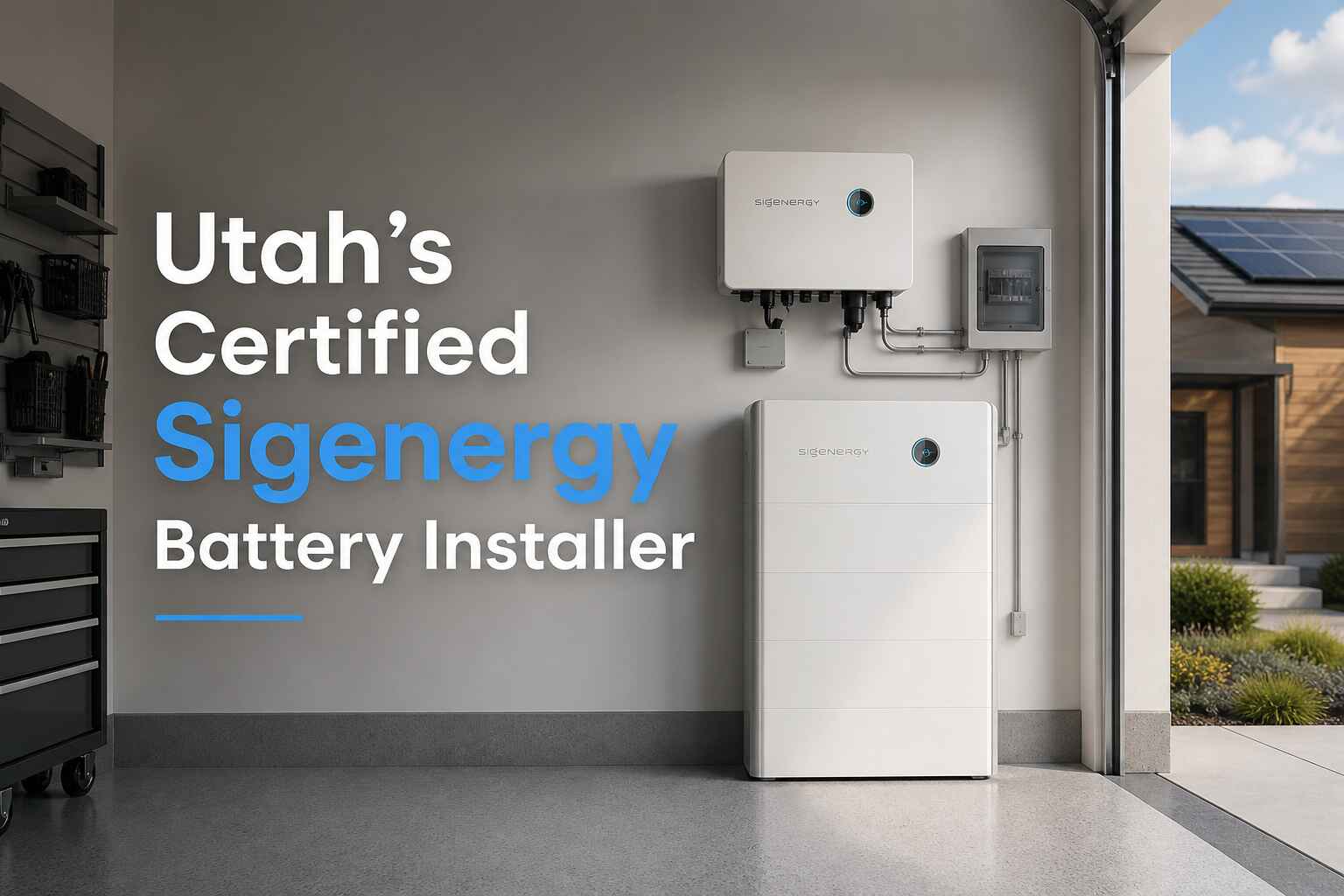
Rocky Mountain Power Territory: Rebate + Rate Structure
If you’re in RMP territory (Sandy, Draper, South Jordan, Herriman, Cottonwood Heights, Midvale, Murray, Salt Lake City, West Jordan, Riverton, Bluffdale, Lehi, Orem, American Fork, Eagle Mountain, Saratoga Springs), the Wattsmart Battery Rebate of $400/kW up to $2,000 applies to every qualified battery installation. No similar incentive exists for generators. This alone means battery systems start with a $2,000 price advantage in most of Utah’s populated communities.
RMP’s time-of-use rate schedules (Schedule 6, 7, 8) also create ongoing daily financial benefit for battery owners — charge the battery cheaply overnight, discharge it to avoid paying peak-hour rates from 4–9PM. This TOU arbitrage benefit is entirely unavailable to generator owners, since generators only run during grid outages.
Utah’s 222+ Sunny Days: Solar Recharge Advantage
Sandy and the greater Salt Lake Valley average 222+ sunny days per year, with peak solar irradiance significantly above the national average. This is a meaningful battery advantage: your system recharges daily from your solar panels at zero marginal cost. A Utah homeowner with 10 solar panels can typically recharge a 13.5 kWh battery 50–90% in a single day from April through October. Even in December, 4–5 peak sun hours are sufficient for substantial daily recharge.
HOA Restrictions: Generators Face More Hurdles
Many of Utah’s newer master-planned communities — especially in Herriman, Saratoga Springs, Bluffdale, Eagle Mountain, and Draper’s southern neighborhoods — have HOA covenants that regulate or prohibit outdoor standby generators due to noise and aesthetics. Battery systems, which are wall-mounted inside a garage or on an exterior wall, almost never trigger HOA restrictions. Before purchasing a generator for a home in a community with an HOA, verify your CC&Rs carefully — we’ve seen homeowners lose $2,000–$3,000 in non-refundable deposits on generators that HOA boards ultimately rejected.
Utah’s Winter Temperature Performance
Cold weather reduces battery performance temporarily. Sigenergy SigenStor operates to −20°C, Tesla Powerwall 3 to −20°C, and Enphase IQ10C to −10°C. For Wasatch Front homes in typical valley locations, all three batteries perform normally through Utah winters. For mountain-adjacent homes above 5,500 ft elevation or in particularly exposed locations, Sigenergy and Tesla’s lower temperature rating is an advantage. Generators are largely unaffected by cold but may need block heaters for reliable cold-start in temperatures below −15°C.
Which Backup Power Option Is Right for Your Utah Home?
There is no universal right answer — the correct choice depends on your specific situation. Here is an honest breakdown of which homeowners we recommend each option to after a free assessment.
- You have solar panels now or plan to add them
- You want to reduce monthly RMP bills year-round (not just during outages)
- You’re in an HOA community with noise restrictions
- You have medical devices that need millisecond switchover
- Your outages are typically under 24 hours (most Utah homes)
- You want to qualify for the RMP Wattsmart rebate ($2,000)
- You drive an EV and want to charge from solar
- You value silent, maintenance-free operation
- You want to increase your home’s resale value
- You’re in Sandy, Draper, South Jordan, Herriman, Lehi, or Orem
- You live in a mountain community with documented multi-day outages
- You don’t have (and don’t want) solar panels
- Your home has extremely high electrical demand that exceeds 27 kWh/day
- You have a natural gas well-pump or livestock water system
- You’re on a rural distribution line with poor reliability history
- You explicitly need 7+ day backup without any solar recharge
- You’re not in RMP territory (Murray, Provo, Spanish Fork)
- HOA does not restrict outdoor generator installation
The “Belt and Suspenders” Option: Battery + Generator
Some Utah homeowners with critical needs (medical equipment + rural location + documented multi-day outages) install both: a solar battery system for daily use, TOU savings, and fast switchover, plus a smaller generator (10kW vs 20kW) as a last-resort backup. The battery handles 95% of outage scenarios silently and cheaply; the generator is available only for the rare extended event. Elite Electric installs both components under a single permit when bundled this way, reducing project cost and coordination time.
“I’ve done detailed load calculations for hundreds of Utah homes. The honest answer for 90% of Salt Lake County homeowners is: a properly-sized solar battery covers every outage you’re actually going to experience, reduces your monthly RMP bill, qualifies for a $2,000 rebate, and adds real resale value. The generator conversation only becomes genuinely justified for mountain homes, rural acreage, or homeowners with extraordinary power demands. I say this as someone who installs both systems.”
Installation & Permitting in Utah — What You Need to Know

Solar Battery Installation Timeline
A standalone solar battery installation in Sandy, Draper, South Jordan, or any Salt Lake County community typically takes one day for a single unit. Elite Electric pulls the required electrical permit in advance, arrives with all materials, completes the installation, configures the monitoring app, and has the system operational before leaving. The city inspection is typically scheduled and passed within 3–5 business days of installation. For solar + battery bundles, allow 2–3 days for the complete project.
Generator Installation Timeline
A standby generator installation is more complex and typically takes 2–3 days. It requires: (1) a concrete pad installation, (2) a natural gas plumber to extend or connect the gas line, (3) a licensed electrician (DOPL required in Utah) to install the automatic transfer switch and connect to your electrical panel, and (4) inspections for both the gas work and electrical work separately. In some Utah cities, a zoning or building review is also required for the pad and exhaust routing. Elite Electric handles the electrical portion; you’ll need to coordinate a licensed plumber for the gas line work.
Utah Permit Requirements for Both Systems
Both battery systems and generators require permits in virtually all Utah cities. For battery storage: an electrical permit from the city is required, and in some jurisdictions a building permit if the installation modifies structural elements. For generators: both a gas permit (pulled by a licensed plumber) and an electrical permit (pulled by a licensed DOPL electrician) are required. Elite Electric pulls the electrical permits for both system types across all of our service area cities. Never allow an installation without the required permits — it voids manufacturer warranties and creates significant liability at resale.
Long-Term Maintenance & Running Costs Compared
Maintenance is one of the most overlooked factors in the battery vs generator decision. The difference is not subtle.
Solar Battery Maintenance: Essentially None
Solar battery systems from Sigenergy, Tesla, and Enphase are solid-state devices with no moving parts. They require no scheduled maintenance, no fluid changes, no filter replacements, and no annual servicing. The monitoring app will alert you to any abnormal performance. Manufacturer warranties cover 10 years (Sigenergy and Tesla) or 15 years (Enphase IQ10C) of normal operation. In 10+ years of installing battery systems across Utah, Elite Electric has experienced fewer than a handful of warranty-covered failures. The systems simply run.
Generator Maintenance: Annual Service Required
Standby generators are internal combustion engines. They require:
- Annual professional servicing ($150–$300): Oil change, spark plug inspection, air filter replacement, coolant check, battery test
- Weekly automatic self-test (30 minutes of full-power operation at 65–75 dB): This is not optional — it’s required by the manufacturer to keep the engine lubricated and battery charged
- Bi-annual load bank testing (recommended by most manufacturers): $200–$400
- Transfer switch testing: Included in annual service
- Engine replacement at 20–30 years: $2,000–$4,000
Over 10 years, generator maintenance costs accumulate to $2,000–$4,000 in servicing alone, before fuel costs. This recurring expense has no battery equivalent.
Environmental Impact & Noise — The Factors Neighbors Notice
Two non-financial factors consistently come up in our conversations with Utah homeowners: noise and environmental footprint. Both favor battery storage clearly.
Noise: The Real-World Difference
A solar battery system produces zero sound during operation. There are no moving parts. Your home transitions to battery backup silently. Your refrigerator hum is the loudest thing in your house.
A Generac 20kW standby generator produces 67 dB at 23 feet — roughly equivalent to a running lawn mower. During the mandatory weekly test cycle (required by manufacturer warranty), this happens automatically at the pre-set test time, whether it’s 6AM on a Saturday or midnight. During an actual multi-day grid outage, your generator runs continuously — 24 hours a day — at that noise level. Your neighbors will know. In Utah’s many newer subdivisions with 6–8 foot lot separations, this matters enormously.
Environmental Footprint
A natural gas standby generator combusts methane and emits carbon dioxide, nitrogen oxides, and water vapor. During an extended outage at full load, a 20kW generator consumes approximately 200 cubic feet of natural gas per hour, or roughly 4,800 cubic feet per day. Over a 7-day outage, this is approximately 33,600 cubic feet of natural gas — the same as heating a Utah home for most of a winter month.
A solar battery system, recharged from solar panels, produces zero direct emissions during operation. The lifecycle manufacturing emissions of lithium-ion batteries are real but are offset within the first 1–2 years of operation compared to fossil fuel alternatives.
Still unsure which option fits your specific Utah home? Tyler Gordon at Elite Electric provides free, no-obligation assessments for both battery storage and generator installation throughout Salt Lake County and Utah County. Your assessment includes a free load analysis, a recommendation, and a written flat-rate quote for the recommended system. See Sigenergy battery options → or call (801) 928-7219.
Warning Signs You Need Backup Power Now — Battery OR Generator
Regardless of which system you choose, these are the signs that your home’s backup power situation is genuinely urgent in 2026.
Conclusion — Which Is Better for Utah Homes in 2026?
The solar battery vs generator Utah decision in 2026 has a clear answer for the majority of Wasatch Front homeowners: a solar battery system is the better long-term investment. It qualifies for a $2,000 RMP rebate that generators don’t. It reduces your monthly utility bill year-round — not just during outages. It switches over in milliseconds rather than seconds. It operates silently. It has no annual maintenance cost. And when paired with solar panels, it recharges daily for free from Utah’s 222+ sunny days.
Whole-home generators remain the right choice for a specific set of Utah homeowners: those in mountain communities with documented multi-day outages, those on rural distribution lines, and those who genuinely need more than 2–3 days of backup power without any solar recharge window. For these homeowners, the generator’s unlimited runtime with natural gas justifies the noise, maintenance, and higher 10-year total cost.
The most important step is a free professional assessment from a licensed Utah electrician who installs both systems and has no financial incentive to sell you one over the other. Elite Electric installs Sigenergy, Tesla Powerwall, Enphase, and generator transfer switches throughout Salt Lake County and Utah County — and we will tell you honestly which system your home needs. Call (801) 928-7219 or request your free written quote online.
Frequently Asked Questions — Solar Battery vs Generator Utah
The installed cost is similar — solar batteries run $9,500–$18,000 and generators run $8,000–$20,000 in Utah. However, solar batteries qualify for the RMP Wattsmart rebate (up to $2,000) while generators do not. Over 10 years, batteries cost significantly less due to $0 fuel cost and $0 annual maintenance versus $4,500–$9,000 in generator running costs. For most Utah homeowners, the battery is cheaper over the life of the system.
Yes, but duration depends on usage. A 13.5 kWh battery (Tesla Powerwall 3 or comparable Sigenergy system) can power essential loads (refrigerator, lights, internet, phone charging, medical devices) for 24–48 hours. Running central AC continuously reduces that to 4–8 hours. For most Utah grid outages, which average 2.7 hours according to RMP’s SAIDI data, a single battery is more than sufficient.
No. Rocky Mountain Power’s Wattsmart Battery Rebate ($400/kW up to $2,000) applies only to qualified battery storage systems, not to standby generators. Solar batteries from Sigenergy, Tesla, and Enphase are on RMP’s approved equipment list. Generators run on natural gas and do not qualify for any RMP energy storage incentive. Elite Electric handles the complete RMP rebate application for every battery installation at no extra charge.
A Generac 20kW standby generator produces approximately 67 dB at 23 feet — roughly equivalent to a running lawn mower or vacuum cleaner. During the mandatory weekly 30-minute self-test (which runs automatically regardless of time of day), this noise level is audible to neighbors in typical Utah subdivisions with standard lot separations. During an actual extended outage, the generator runs continuously at that noise level 24 hours a day. Solar batteries produce zero noise during operation.
A single solar battery installation (Sigenergy, Tesla Powerwall, or Enphase) typically takes one day in Sandy, Draper, South Jordan, and surrounding Salt Lake County cities. Elite Electric pulls the required electrical permit in advance, arrives with all equipment, completes installation and app configuration, and has the system operational before leaving. City inspection is usually scheduled within 3–5 business days. Solar + battery bundles take 2–3 days total.
Many Utah HOA communities — particularly in Herriman, Saratoga Springs, Bluffdale, Eagle Mountain, and parts of Draper — restrict or require approval for standby generators due to noise and aesthetic concerns. Solar batteries, installed on a garage wall or exterior wall, almost never trigger HOA restrictions. Before purchasing a generator for an HOA community, review your CC&Rs carefully. Elite Electric recommends getting written HOA approval before any generator deposit is placed.
For most Utah homes in 2026, Sigenergy SigenStor offers the best value (from $9,500 installed) with the widest temperature range (−20°C) and modular scalability. Tesla Powerwall 3 is best for Tesla EV owners due to native vehicle integration. Enphase IQ10C is best for homes already running Enphase microinverter solar panels. Elite Electric is Utah’s only authorized Sigenergy dealer and a certified installer for Tesla and Enphase — and will recommend the right system after a free home assessment.
Yes. Research from Lawrence Berkeley National Laboratory indicates solar plus battery systems add $15,000–$25,000 to assessed Utah home values depending on system size. Battery-only systems (without solar) add less, but backup power capability and reduced utility bills are increasingly valued by Utah homebuyers in 2026. Standby generators typically add $3,000–$5,000 in perceived value but depreciate as mechanical systems age. Solar batteries appreciate in value relative to generators over time.
Yes, with proper system sizing. A Level 2 EV charger draws 7.2–11.5 kW continuously. To charge an EV during an outage while also powering essential home loads, you need a battery system with sufficient continuous output (Tesla Powerwall 3’s 11.5 kW output or multiple Sigenergy units) and adequate stored capacity. Elite Electric designs battery systems with EV charging requirements in mind during the free load analysis. Many Sandy and Draper homeowners run their Tesla Model Y overnight from Powerwall backup during outages with properly sized systems.
With solar panels, the payback period for a battery + solar bundle in Utah is typically 7–10 years, accounting for RMP bill reduction from net metering and TOU avoidance, plus the $2,000 RMP Wattsmart rebate. Battery-only (without solar) payback is 12–16 years based on TOU arbitrage alone. Payback improves as electricity rates rise — RMP has increased residential rates by an average of 4–6% annually in recent years, making the battery investment more valuable over time.
Yes. During a grid outage, your battery discharges its stored energy regardless of weather — the sun does not need to be shining for the battery to power your home. Cloudy weather reduces solar recharge rate (typically to 15–40% of full output) but does not prevent the battery from functioning. Even during Utah’s cloudy December and January days, 3–4 hours of partial sun provide meaningful recharge. The battery itself operates normally in all weather conditions within its temperature rating.
A Generac standby generator installed in Salt Lake County or Utah County costs $8,000–$20,000 depending on size. A 13kW Generac runs $8,000–$12,000 installed. A 20kW Generac runs $11,000–$16,000 installed. These prices include the automatic transfer switch, pad, and standard electrical work, but may not include gas line extension ($500–$2,500 extra) or HOA application fees. Annual maintenance adds $150–$300/year and natural gas fuel adds $300–$600/year for typical use.
Related Articles

More from Elite Electric
Get Your Free Solar Battery or Generator Assessment — Utah 2026
Tyler Gordon at Elite Electric provides free, written flat-rate quotes for Sigenergy, Tesla Powerwall 3, Enphase IQ10C, and generator transfer switch installations throughout Salt Lake County and Utah County. Sandy HQ · Mon–Sat 9AM–5PM · Emergency 24/7